Receive verified new-post alerts without creating an account.

A Post Should Not Disappear After Publication
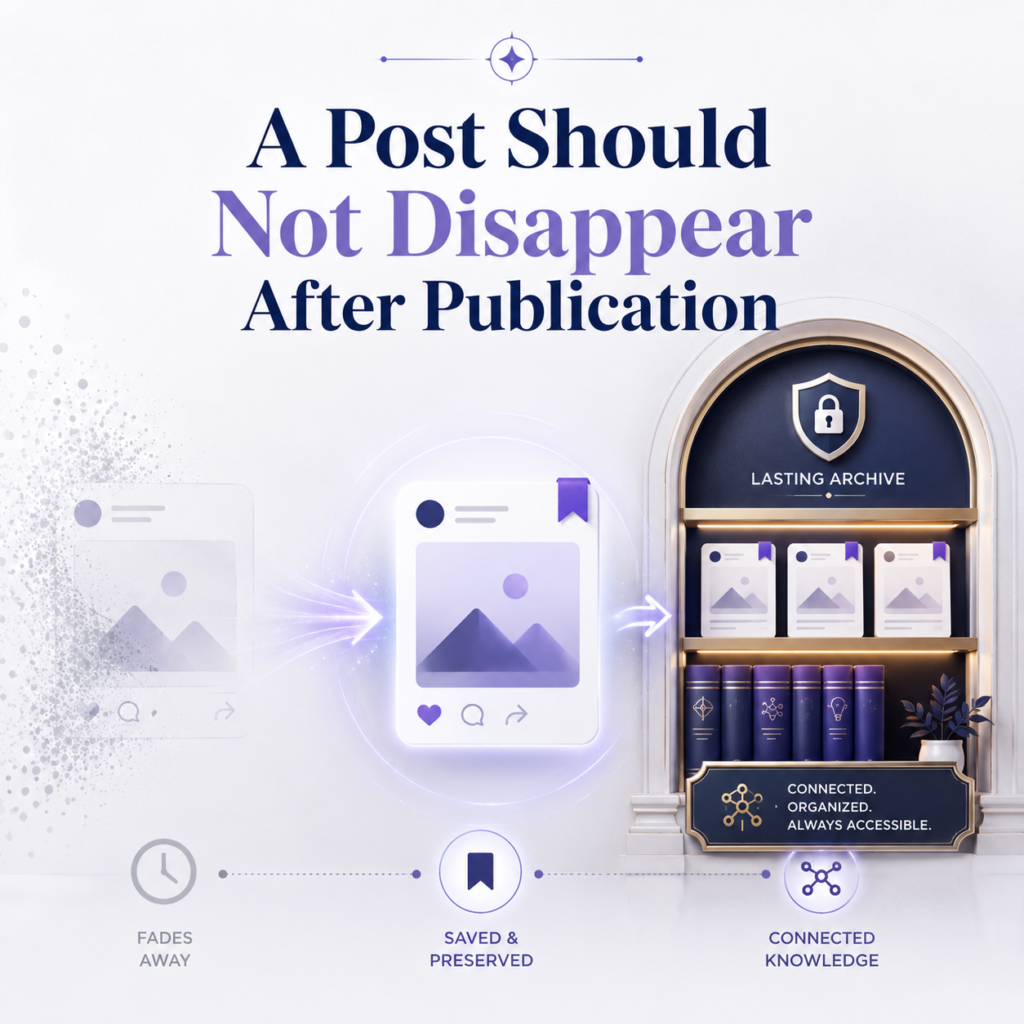
Most posts are written for the present moment.
They receive some views, reactions, or comments—and then gradually disappear under newer content. Even when the information remains useful, finding it later becomes difficult.
But what if a post was treated as a permanent knowledge unit?
A post may contain a decision, lesson, announcement, reflection, research idea, business observation, legal thought, educational explanation, or institutional update. These are not always large enough for a complete website page, but they are often too important to lose.
Postbook gives these posts a structured home.
Every Postbook post can remain connected with its author, website, category, related pages, and original publication date. It can be searched, shared, indexed, updated, and reused when needed.
This changes the role of a post.
A post is no longer only temporary content for social media. It becomes part of an organized and growing archive.
The local Postbook remains the official source. Social platforms help distribute the message. The central Postbook News Feed will help people discover posts from connected brands, companies, schools, and projects.
The purpose is simple:
Publish once. Store properly. Connect intelligently. Reuse when necessary.
Postbook is being developed so that useful posts do not disappear after publication. They remain part of a connected system of authentic information.
One Platform, Where Posts Connect
A company may have its own website. A school may publish educational updates. A founder may share personal experiences. A research project may publish new ideas.
But when every post remains isolated, people may never understand how these ideas and organizations are connected.
Postbook is being developed to solve this problem.
Each brand, company, school, and project can maintain its own independent Postbook. It can publish normally, preserve its own identity, and remain the official owner of its content.
At the same time, connected Postbooks will be able to send their public posts to one central Postbook News Feed.
The newest posts will appear first. Visitors will be able to discover posts from different connected Postbooks through one consistent interface while every original post remains linked to its official website.
This is why our Postbook theme is:
One Platform. Where Posts Connect.
The goal is not to create another noisy social-media platform.
The goal is to create a structured network where authentic posts can be stored, discovered, distributed, and connected across our ecosystem.
We have already completed the basic local Postbook system. The next stage is connection—bringing independent Postbooks together through one shared news feed.

Why DH Sakib Created Postbook
For a long time, I have been working with different companies, schools, research projects and online platforms under Lilac Group. Naturally, we publish many posts, videos, updates and ideas. But after publishing them on Facebook, LinkedIn or other platforms, important content often becomes difficult to find again.
That made me think: Are we creating our own digital assets, or are we only creating content for other platforms?
Social media is still important for reaching people, and we will continue using it. But I also wanted a place where our posts could remain permanently connected with the company, school or department that originally published them. This simple need gradually became the idea of Postbook.
At first, I only wanted to preserve my own daily posts. Later, I realised that the same problem exists across our whole ecosystem. One school may publish something useful for another school, and one company’s experience may help another department. However, these ideas often remain separated across different websites.
Postbook connects those separate voices without removing their individual identities. Every organization can have its own Home feed, while the News Feed helps people discover posts from connected companies and schools. The original post remains with its original publisher, but useful knowledge can travel across the network.
For me, Postbook is not an alternative to Facebook or YouTube. It is our own permanent foundation. External platforms can give us reach, while Postbook keeps the original record under our own control.
I created Postbook because I believe a useful post should not disappear after a few days. An idea, decision or part of an organization’s journey should remain visible, searchable and connected with its source.
That is the purpose behind Postbook:
One Platform. Where Posts Connect.
— DH Sakib

You’re all caught up.
